
01 November, 2025
In Islam, cleanliness and purity are not just physical acts — they are deeply spiritual practices that prepare the believer to stand before Allah in worship. For women, understanding the rules and method of ghusl after janabah is especially important, as it relates to daily life, marital intimacy, and acts of worship. This guide explains in detail what janabah means, when ghusl becomes necessary, and how women can perform it correctly according to Islamic teachings.
The term janabah refers to a state of major ritual impurity that occurs due to marital relations or the release of sexual fluids, whether during intercourse or through other means. When a woman experiences janabah, she cannot perform acts of worship such as Salah (prayer), reciting the Quran, or fasting until she performs ghusl after janabah.
Allah says in the Quran:
“And if you are in a state of janabah, then purify yourselves.” (Surah Al-Ma’idah, 5:6)
This command shows that ghusl is a divine obligation and a necessary act of purification before resuming worship.
Women are required to perform ghusl in the following situations:
-
After marital intimacy, even if there is no ejaculation.
-
When sexual fluids are released due to desire, dreams, or stimulation.
-
After menstruation (hayd) or postpartum bleeding (nifas).
-
After conversion to Islam.
Even if a woman experiences janabah without physical intercourse, the release of sexual fluids due to excitement or a wet dream makes ghusl obligatory.
For many women, ghusl after janabah is not only a requirement but a spiritual refreshment. It marks a transition from impurity to purity, from privacy to prayer. It symbolizes renewal — physically, emotionally, and spiritually.
During ghusl, a woman cleanses herself completely, preparing her heart and body for connection with Allah. This act of purification also brings mental clarity and serenity, reminding her that Islam values both inner and outer cleanliness.
Before performing ghusl after janabah, it is important for a woman to prepare properly. Here are some steps to help ensure ghusl is done correctly and comfortably:
-
Privacy and Modesty
Choose a private place where you feel safe and comfortable. Islam values modesty even when alone. -
Clean the Body First
Remove any traces of dirt, discharge, or makeup that might prevent water from reaching the skin. -
Remove Nail Polish
If you have nail polish or anything that forms a barrier, remove it before ghusl. -
Comb or Untie Hair if Necessary
Women with long or braided hair should ensure that water reaches the roots. If the hair is tightly braided, it’s sufficient to let water reach the scalp, but untying is better if possible.
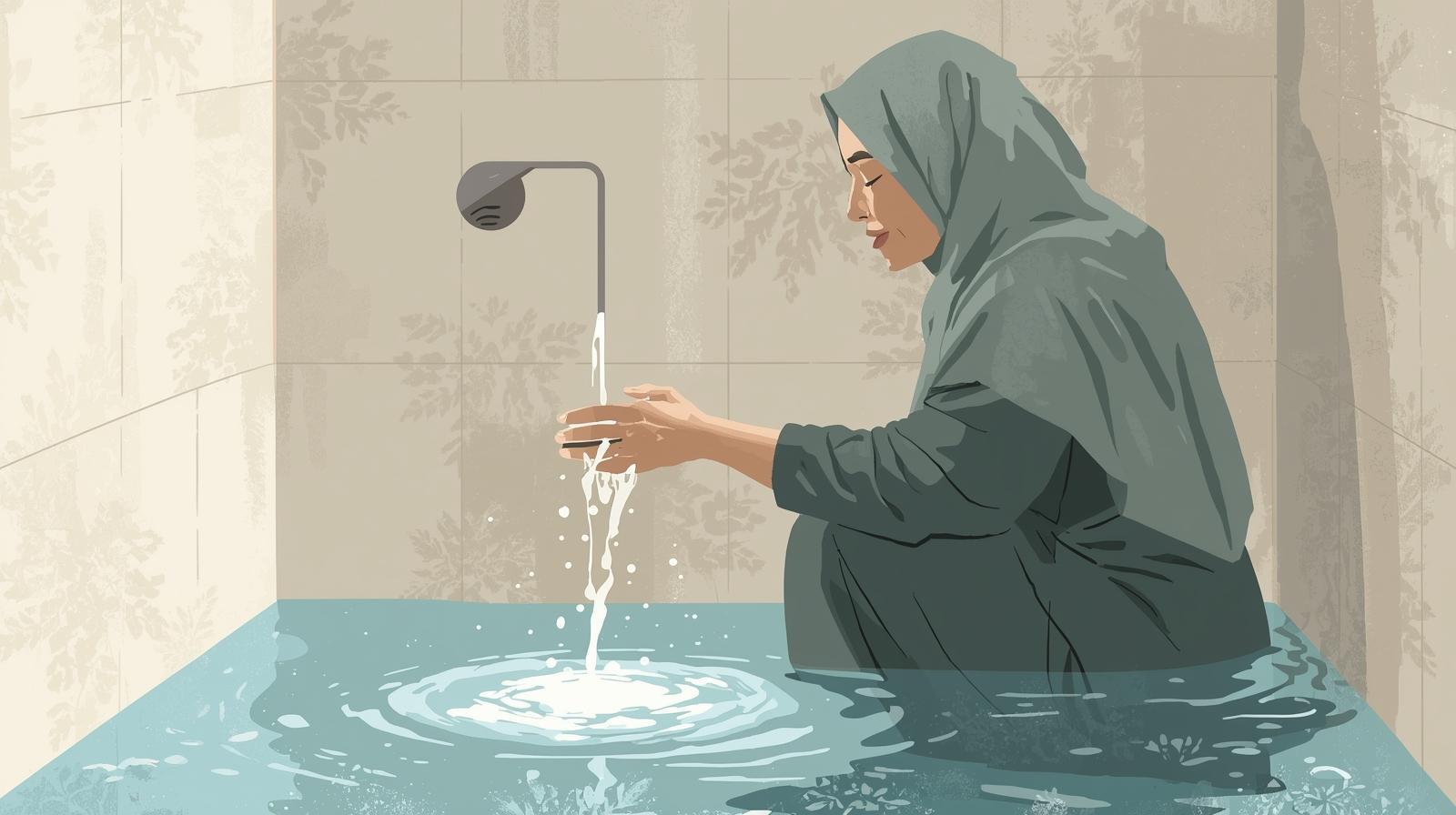
The Prophet Muhammad ﷺ provided a clear and simple method for ghusl. Here is a detailed guide to help women perform it correctly:
1. Make the Intention (Niyyah)
Start by making a sincere intention in your heart that you are performing ghusl to remove the state of janabah for the sake of Allah. No verbal statement is needed — intention is internal.
2. Say “Bismillah”
Begin the process by saying “Bismillah” (In the name of Allah).
3. Wash the Hands
Wash both hands up to the wrists three times to ensure cleanliness before touching other parts of the body.
4. Wash Private Parts
Clean the private areas thoroughly with the left hand to remove any impurities or discharge.
5. Perform Wudu
Next, perform wudu (ablution) as you would before prayer. This includes washing the face, arms, wiping the head, and washing the feet.
Some women prefer to delay washing the feet until the end of ghusl if the bathroom floor is unclean — both ways are acceptable.
6. Pour Water Over the Head
Pour water over the head three times, ensuring it reaches the roots of the hair and scalp.
If your hair is long, it’s not necessary to wash every strand, but the water must reach the scalp.
The Prophet ﷺ told Asma bint Shakal:
“It is sufficient for you to pour three handfuls of water over your head, then pour water over your body.” (Muslim)
7. Wash the Entire Body
Starting with the right side, then the left, pour water over your whole body. Make sure water reaches every part — under the arms, behind the ears, between fingers and toes, and under folds of skin.
8. Rub the Body
While washing, gently rub the body to ensure no part remains dry. This also enhances cleanliness and ensures complete purification.
To make it easier to remember, here’s a simple summary of ghusl after janabah for women:
-
Make intention (niyyah).
-
Say “Bismillah.”
-
Wash hands three times.
-
Wash private parts.
-
Perform wudu.
-
Pour water over head three times.
-
Wash entire body starting from the right side.
-
Rub the body to ensure water reaches everywhere.
Although both involve full-body washing, there is a slight difference in purpose and timing:
-
Ghusl after janabah is performed after marital intimacy or sexual discharge.
-
Ghusl after menstruation is done after the bleeding stops completely.
The method of ghusl is the same in both cases, but the intention differs — one for janabah, and the other for purification from menstrual impurity.
Even though ghusl is straightforward, some common mistakes can make it incomplete or invalid. Here are points women should avoid:
-
Forgetting to make the intention.
-
Leaving parts of the body dry (like under the hair or armpits).
-
Keeping nail polish or waterproof makeup that prevents water contact.
-
Rushing through ghusl without mindfulness.
-
Neglecting to perform wudu before or during ghusl.
Taking a few extra moments to ensure thorough washing makes ghusl both valid and spiritually uplifting.
Q1: Do I need to perform ghusl if only sexual thoughts occur without discharge?
A1: No, ghusl is not required unless there is an actual release of sexual fluid or marital intimacy occurs.
Q2: Can I perform ghusl while having braided hair?
A2: Yes, you can keep your braids, as long as water reaches the roots of the hair and scalp. It’s not necessary to unbraid every time.
Q3: Does ghusl replace wudu?
A3: Yes, if ghusl is performed completely with wudu included in it, you do not need to perform a separate wudu afterward.
Q4: Can I perform ghusl without showering if water is limited?
A4: If water is unavailable or limited, tayammum (dry ablution using clean soil) can temporarily replace ghusl until water becomes available.
Q5: What if I forget to wash a small part of my body?
A5: If you remember shortly after ghusl, simply wash that part without repeating the whole ghusl. But if much time has passed, it’s safer to repeat it completely.
